
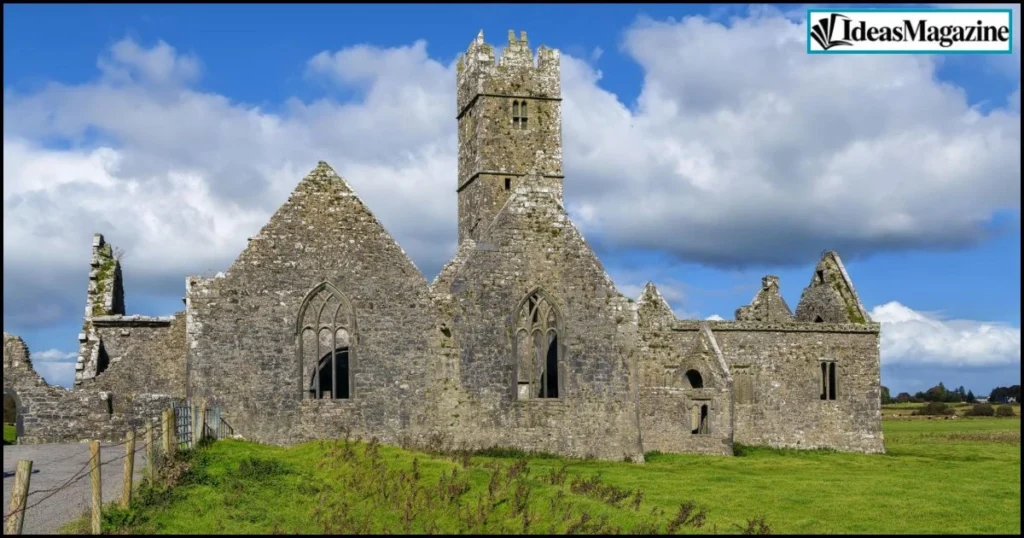
Ross Errilly Friary Ireland is one of the most remarkable medieval religious sites in County Galway. Set in a quiet rural landscape near Headford, this former Franciscan community offers visitors an unusually complete picture of how friars lived, worshipped, worked and organised their daily lives. Unlike many historic religious buildings that survive only as partial walls, Ross Errilly retains substantial sections of its church, domestic ranges, cloister and kitchen buildings.
The site is also interesting because its history is not entirely settled. Historians have suggested different foundation dates and possible founders, while its surviving architecture reflects several periods of development. Today, the friary is a state-owned National Monument cared for by the Office of Public Works (OPW). Visitors can explore the atmospheric ruins independently during daylight hours, making it a worthwhile stop for anyone interested in Irish history, medieval architecture and heritage attractions.
What Is Ross Errilly Friary Ireland?
Ross Errilly Friary is a former Franciscan friary in County Galway, Ireland. It was established for members of the Franciscan religious order, whose way of life traditionally emphasised prayer, preaching, community living and service. The surviving complex includes a church, tower, chapels, domestic buildings and the remains of spaces used for everyday activities. Its scale and level of preservation make it an important example of a medieval Franciscan settlement in Ireland.
The site is sometimes called Ross Errilly Abbey, although friary is the more accurate description because it belonged to the Franciscan order. It stands in a peaceful countryside setting close to the Black River and the village of Headford. Much of the visible architecture developed during the fifteenth and sixteenth centuries, even though the proposed foundation date may be earlier. The combination of religious buildings and domestic spaces makes the site particularly valuable for understanding how a Franciscan community functioned.
Where Is Ross Errilly Friary Located?
Ross Errilly Friary is situated near Headford in County Galway, in the west of Ireland. It lies approximately 2 kilometres north-west of Headford village, close to the Black River, which forms part of the natural boundary between Galway and Mayo. The surrounding landscape is rural and relatively quiet, giving the historic ruins a sense of separation from modern development. Galway city is around 30 kilometres away, although the exact journey depends on the route and starting point.
Visitors travelling from Galway can drive towards Headford and follow local directions for Ross Errilly. The final approach is along a narrow country road, so drivers should be prepared to slow down and give way where necessary. Public transport options may take visitors as far as nearby towns or villages, but the friary itself is not a major transport hub. Checking the route before setting off is sensible, particularly for anyone unfamiliar with rural roads in this part of Ireland.
What Is the History of Ross Errilly Friary?
The history of Ross Errilly Friary reflects the changing religious and political conditions of Ireland over several centuries. The Franciscan community developed during the late medieval period and benefited from the support of influential local families. The Clanricarde Burkes became particularly important patrons and protectors, helping the friars remain connected with the site during periods of religious suppression and political uncertainty. The friary was not simply a place of worship; it also served the spiritual needs of the surrounding population.
Its history included periods of disruption, military violence and changes in ownership. The English Crown confiscated the friary in 1538, during the wider suppression of religious houses under Henry VIII. However, the community did not disappear permanently at that point. The friars returned at different times with the support of local patrons, despite further attacks and restrictions. Cromwellian soldiers desecrated the site in 1656, and later anti-Catholic legislation made religious life increasingly difficult. The surviving buildings therefore represent a long and complicated history rather than one uninterrupted period of use.
What Happened to Ross Errilly Friary in 1656?
On 10 August 1656, during the Cromwellian period, soldiers attacked and desecrated Ross Errilly Friary. Heritage Ireland records that they entered the site and disturbed coffins while searching for valuable objects, including gold, silver and precious stones. The incident forms one of the darkest episodes in the friary’s history and reflects the wider religious and political violence affecting Catholic communities in Ireland during this period.
The attack did not mean that Franciscan activity in the area ended permanently. Historical accounts describe the friars returning after periods of hiding and disruption, with local protection helping them maintain a presence. However, later restrictions, including the Popery Act of 1698, placed further pressure on Catholic religious communities. Heritage Ireland records a return to the friary in 1715, followed by continued occupation until around the middle of the eighteenth century. The later closure of a Franciscan community at Kilroe Hill in 1832 is a separate event and should not be confused with the abandonment of the original friary.
What Are the Main Architectural Features of Ross Errilly Friary?
The architecture of Ross Errilly Friary is one of its most impressive features. The complex contains a substantial church, a tower, additional chapels and domestic buildings arranged around a main cloister and an outer court. The church includes a nave and chancel, while the expanded southern section features a distinctive double transept. These additions provided space for extra chapels and altars, reflecting the importance of private devotion and the support of wealthy local benefactors.
The domestic ranges reveal how the friars organised their everyday lives. The main cloister had a central open space, known as the cloister garth, surrounded by a covered walkway that connected different parts of the complex. The outer court was a separate working and circulation area, not simply another name for the covered cloister. The kitchen, refectory, dormitory spaces and other service buildings were arranged around these areas. A tower built in 1498 is among the notable dated features, although other parts of the complex developed over different periods.
Why Is Ross Errilly Friary Historically Important?
Ross Errilly Friary is important because it preserves a substantial example of a medieval Franciscan settlement in Ireland. Many historic religious sites have lost most of their original buildings, but Ross Errilly retains enough of its layout to show the relationship between the church, cloister and domestic ranges. Its surviving features provide useful evidence for the study of medieval religious architecture, Franciscan life and the development of religious communities in the west of Ireland.
The friary also offers insight into the influence of local families and the impact of political and religious change. The Gannards and Clanricarde Burkes are both associated with its foundation history and patronage, although their precise roles remain debated. Its confiscation, periods of renewed Franciscan occupation and the 1656 attack illustrate the difficulties faced by Catholic religious communities. As a protected National Monument, the site remains an important part of Galway’s heritage and a valuable place for visitors interested in Ireland’s past.
Can You Visit Ross Errilly Friary Ireland?
Yes. Ross Errilly Friary is open to visitors as an unguided heritage site, with access available during daylight hours according to Heritage Ireland. It is cared for by the Office of Public Works and is protected as a state-owned National Monument. Visitors can walk around the surviving structures, view the church and domestic remains, and explore the historic layout at their own pace. There is no need to book a standard guided visit for independent access.
Because the friary is a historic ruin rather than a modern visitor attraction, facilities and interpretation on site are limited. It is best suited to people who enjoy exploring historic buildings and reading architectural details for themselves. Allow time to walk carefully around the different sections instead of treating it as a quick photo stop. Before travelling, check the official Heritage Ireland visitor information for Ross Errilly Friary for the latest access notices and any temporary restrictions.
Is There an Entrance Fee or Parking at Ross Errilly Friary?
Ross Errilly Friary is listed by Discover Ireland as free to visit, and free car parking is also listed. This makes it a useful option for travellers looking for a heritage attraction in County Galway without the cost of a ticket. However, visitors should check current official information before setting out, as access arrangements at historic sites can occasionally change. There is no need to assume that a free site will have the same facilities or visitor services as a staffed attraction.
Heritage Ireland lists a car park among the facilities, but the approach road is narrow and rural. Drivers should take care when meeting other vehicles and avoid blocking access for residents or other visitors. The site is not presented as a fully serviced visitor centre, so it is sensible to bring any refreshments or supplies you may need before arriving. Do not expect extensive parking facilities, cafés or indoor visitor services at the friary itself.
What Other Attractions Are Near Ross Errilly Friary?
Headford is the nearest village and a practical place to include in a short visit to the area. Its location makes it a useful starting point for exploring the surrounding countryside and nearby heritage sites. The Black River and the rural landscape around the friary also add to the experience, particularly for visitors who enjoy quiet drives and historic locations away from larger tourist centres. The area can be explored as part of a wider County Galway itinerary rather than as a destination that requires a full day on its own.
Travellers with more time can combine Ross Errilly with a visit to Galway city or other attractions around Lough Corrib, depending on their route and interests. Galway offers a wider choice of museums, historic streets, restaurants and cultural experiences, while the countryside around the lake provides opportunities to discover more of the region. Check distances and travel times before planning several stops, as rural roads can make journeys longer than the map suggests. Ross Errilly works particularly well as a heritage stop during a day exploring the wider Galway area.
(FAQs)
1. Where Is Ross Errilly Friary in Ireland?
Ross Errilly Friary is located near Headford in County Galway, in the west of Ireland. It is approximately 2 kilometres north-west of Headford village and around 30 kilometres from Galway city, depending on the route.
2. When Was Ross Errilly Friary Built?
The exact foundation date is debated. Heritage Ireland associates its establishment with the mid-fourteenth century and Sir William de Burgo, while Monastic Ireland suggests that around 1460 may be a more likely date. The Gannard and Clanricarde families are both associated with its early history and patronage.
3. Is Ross Errilly Friary Free to Visit?
Yes. Discover Ireland lists free admission to Ross Errilly Friary. Visitors should check the official Heritage Ireland website before travelling in case access arrangements or temporary restrictions have changed.
4. Who Destroyed Ross Errilly Friary?
Ross Errilly Friary experienced damage and desecration during different periods. One particularly serious incident occurred on 10 August 1656, when Cromwellian soldiers entered the friary, disturbed coffins and searched for valuables. The site was not completely destroyed, and substantial parts of its medieval buildings remain.
5. Can You Explore Ross Errilly Friary Without a Guided Tour?
Yes. Ross Errilly Friary is an unguided heritage site, allowing visitors to explore the ruins independently during daylight hours. There is no need to arrange a standard guided tour for ordinary independent access, although visitors should check Heritage Ireland for current information before their journey.
Conclusion
Ross Errilly Friary Ireland is a valuable destination for anyone interested in medieval history, Franciscan architecture and the religious heritage of County Galway. Its surviving church, tower, cloister and domestic buildings offer a rare opportunity to understand how a medieval friary was organised and how its community lived. The site’s complicated history, including its disputed foundation date, periods of religious suppression and the attack of 1656, makes it especially interesting to explore.
Today, visitors can experience these historic ruins independently, with free admission and parking listed by Discover Ireland. Its peaceful countryside location near Headford also makes it a convenient heritage stop when exploring the wider Galway region. Whether you are interested in Irish history or simply want to discover a lesser-known historic site, Ross Errilly Friary provides a meaningful glimpse into Ireland’s medieval past.
Pingback: Bottomless Brunch Bath: 6 Best Places & Prices